
The government is expected to dole out some populist policies, especially for the rural / farm sector while presenting the interim budget, given that the country is heading towards general elections over the next few months.

China must maintain medium-high growth for the next five years.

China has overtaken the US as the world largest online retail market with $442 billion compared to US.

In 2015, the Reserve Bank of India cut interest rates by 125 basis points to 6.75 per cent.

Institutional investors - both foreign and domestic - lapped up the government's big-ticket share sales on Friday, helping it add nearly Rs 9,000 crore to its revenue kitty.

The greatest disconnect lies in the estimates of industrial growth.
Corporate leaders said a stable government at the Centre will help boost infrastructure spend, address agricultural distress, and encouraging employment.

The state of health is a reflection of what is spent and how it is spent.
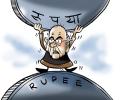
For the first eight months of the current financial year, the figure stood at Rs 7.17 trillion.

Bengaluru dominates Karnataka's economy and its infrastructure mess compounds the problems, with policies lagging need and expectations.
.jpg)
The latest macro-economic numbers confirm the economy trundles along in a low growth trajectory, while inflation climbs.

Being mandatory, these recommendations will have to be immediately built into the Budget for 2015-16.

The economy could grow at 6-6.5 per cent this fiscal year (2019-20 or FY20), said Chief Economic Advisor Krishnamurthy Subramanian, revising his earlier estimate of 7 per cent in the Economic Survey. In an interaction with Arup Roychoudhury, he said supply-side measures, including corporation tax cuts, will boost consumption and demand, and non-tax revenue may make up for shortfall in tax revenues.

The NDA is looking to reduce fiscal deficit not by chopping social sector spending but by paring it down
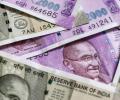
Post office savings deposit, recurring deposit accounts and the senior citizen savings scheme account have shown the highest growth in the current financial year.

There are a couple of proposals, however, whose goals are not easily achievable.
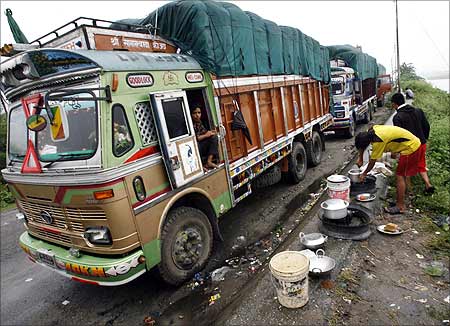
Implementation of GST is expected to increase the gross domestic product of the country.

This rate of growth has a number of implications.
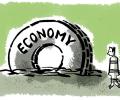
Moody's Investors Service on Friday projected India's growth at zero per cent for the current fiscal and said the negative outlook on sovereign rating reflects increasing risks that GDP growth will remain significantly lower than in the past. The outlook also partly shows weaker policy effectiveness to address economic and institutional issues, it noted in the update to its November 2019 rating forecast.

Crisil said a complete phase out of CST is necessary.
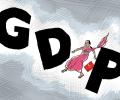
'Given that the economy is going through a slowdown, further downward revisions of the 2019-2020 growth estimates cannot be ruled out,' notes A K Bhattacharya.

The most serious recommendations to change the financial year came in the years preceded by deficient rainfall. The Jha committee was formed after droughts in 1979-80 and 1982-83, reports Rishika Pardikar/IndiaSpend.

Much of the rural recovery story is based on the premise of agriculture doing well. Even if it clocks a growth of 2.5-3 per cent this year, it is still just around 15 per cent of the overall GDP. The non-farm sector, which constitutes a bigger portion of the overall rural economy, is now hampered by disruptions and lockdowns.

With nearly 100 countries closing national borders during the past month, the movement of people and tourism flows have come to a screeching halt. The contraction could be even higher if governments fail to provide income support and help boost consumer spending.

Income velocity based on currency with the public went down from 0.93 in October to 0.84 in March says a report from SBI's economic research department

Sources close to the PM say he will not be panicked into generating short-term results at the cost of longer-term goals

India's overall retail inflation eased to 4.41 per cent in September, helped by falling commodity prices, but rural inflation was at 5.05 per cent

After the government sought Parliament's nod for a second batch of supplementary demand for grants that will cause a hit of Rs 2.99 trillion to the exchequer, doubts suddenly arose about the government's ability to meet the Budget projections of reining in its fiscal deficit at 6.8 per cent of gross domestic product (GDP), or Rs 15.06 trillion, for the current financial year. Till now, many were of the opinion that the government would succeed in checking the deficit at a much lower figure than what was given in the Budget Estimates (BE). The government had sought Parliament's approval to spend Rs 3.74 trillion extra, but Rs 74,517.01 crore will be matched by equal savings on other heads.
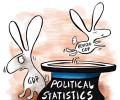
There has been criticism of the official statistics ever since MoSPI came out with new methodology to estimate the GDP on the base year of 2011-12 compared to earlier 2004-05.
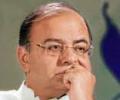
The finance minister said the economy had been slowing.

The Indian rupee is down nearly 2 per cent against the US dollar since the beginning of January 2019. Experts attribute the Indian rupee's relatively poor performance to a sharper-than-expected fall in economic growth in India.

She needs to find innovative ways to at least match the growth during Gehlot's rule.

The total rainfall till now is not only deficient, but is also erratic in terms of both geographical spread and timings.

In recent past, midcap stocks have performed well, say experts.

The government plans to raise resources to finance capital spending beyond the Rs 3.10 lakh crore budgeted for 2017-18 through higher borrowing or divestment receipts.

A normal monsoon, softer interest rates and inflation, pent-up demand, along with mild budgetary support may help growth pick up in coming quarters.

The steady decline of economy recently made Chinese youth anxious.

'Whatever happens in any part of the world affects us.'

India has now moved up 1 position to 29th.

The U.S. economy grew faster than initially thought in the second quarter.
